
Compliance Documents a Vegan Private Label Perfume Needs From Its Factory
A vegan claim on a perfume label is a marketing position that has to survive the documentation. The factory's job is to prove that the formula contains no animal-derived materials and that every ingredient is disclosed at the level the destination market requires. The buyer's job is to collect that proof at the moment it is produced, because it cannot be reconstructed from memory later. This article lists the documents a vegan private label perfume needs, and the order in which they should arrive.
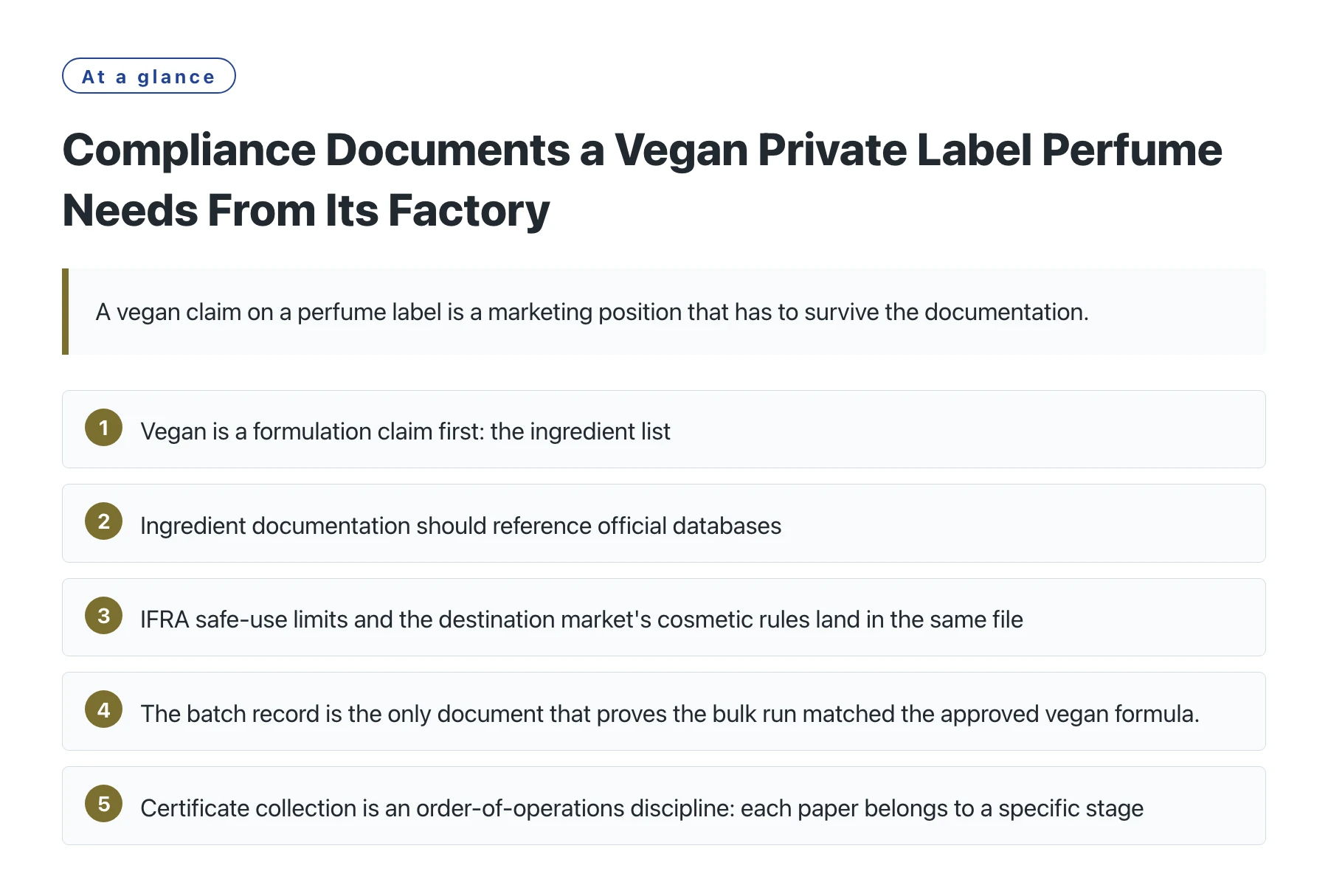
Key takeaways
- Vegan is a formulation claim first: the ingredient list, not the label, is where the proof lives.
- Ingredient documentation should reference official databases, because a claim that cannot be checked is a claim that will be challenged.
- IFRA safe-use limits and the destination market's cosmetic rules land in the same file, and both are inputs to the formula, not afterthoughts.
- The batch record is the only document that proves the bulk run matched the approved vegan formula.
- Certificate collection is an order-of-operations discipline: each paper belongs to a specific stage, and missing it means re-opening the file.
Vegan positioning is one of the fastest-growing claims in fragrance, and one of the most specific to defend. A bottle that says vegan commits the brand to a formulation fact, not a feeling. Regulators and retailers both know how to ask; the brand that cannot produce the paper loses before the argument starts.
This article is written for brand owners and product managers launching a vegan private label perfume, and it assumes the factory is selected but the file is not yet built.
What vegan means for the formula
A vegan perfume is a perfume whose composition contains no animal-derived materials — no musk from animal sources, no beeswax, no shellac-based colourants — and whose development does not depend on animal testing. The definition sits in the ingredient list, which is why the first document is always the full formula disclosure.
For the EU the ingredient reference point is CosIng, the Commission's ingredient database, and a formulator who documents against it produces a file that downstream regulators can check quickly [1]. For vegan claims in particular, the disclosure has to reach the level of the raw materials actually used, including diluents and preservatives.
At the same time, the formula has to sit inside IFRA's safe-use limits for fragrance materials; those limits are published standards that formulators build to, and the finished concentrate's IFRA statement is a standard deliverable [2].
The documents, in the order they appear
| Document | What it proves | Stage it belongs to |
|---|---|---|
| Formula disclosure | Which materials are in the concentrate | Development |
| Ingredient reference | Materials are identifiable against an official database | Development |
| IFRA statement | Safe-use limits are respected | Development |
| Vegan attestation | No animal-derived materials, no animal testing | Sample approval |
| Batch records | The bulk run matches the approved formula | Pilot and bulk |
| Product information file | The market's documentation requirements are met | Before shipping |
The list is short and the order is strict. A paper that appears at the wrong stage is usually a re-open, and a re-open is calendar time.
What to check with the factory
Ask where the vegan proof lives in the supplier's process. Some factories maintain a declared vegan material list; others verify per project. Either is workable, but the discipline has to be documented, because the vegan claim depends on the whole chain, not on one certificate.
The selection stage matters too: capacity and quality in private label perfume are two different promises, and vegan documentation sits awkwardly between them — capacity gets you the run, quality gets you the file. That distinction is worth reading carefully before you choose capacity and quality in private label perfume.
For a first vegan line, the fast route is private label fragrance production, where the base is proven and the documentation pattern already exists; the vegan work then concentrates on ingredient verification rather than formula invention private label fragrance production.
Finally, ask what the factory's safety testing covers. Safety testing in perfume manufacturing is the step that produces the microbiological and stability data the file needs, and a vegan formula with natural-derived materials has to pass exactly the same testing as any other safety testing in perfume manufacturing.
The compliance sequence that protects the claim
- Collect the formula disclosure firstGet the full concentrate composition in writing before the first sample is approved. This is the reference every other document checks against.
- Verify each ingredientMatch materials against the ingredient database and confirm the vegan status of each, including diluents and colourants.
- Request the IFRA statementWith the sample, not after bulk. The safe-use statement belongs beside the approved sample.
- Lock the vegan attestation at sample sign-offA signed, dated attestation that the approved formula contains no animal-derived materials and involves no animal testing.
- Re-verify at bulk releaseCompare batch records against the approved formula. Vegan proof is only as strong as the weakest batch.
The single most common failure is a verbal vegan confirmation at sales stage, discovered to be unverifiable at audit. Write the vegan proof into the order of operations the same way you write the price. The claim, the file and the launch date all depend on it.
Sources
- EU CosIng — Cosmetic Ingredient Database (European Commission) —— The European Commission's CosIng database of cosmetic ingredients, listing ingredient functions, restrictions and labelling requirements under EU cosmetics law.
- IFRA Standards Library (International Fragrance Association) —— The IFRA Standards Library lists the restrictions the fragrance industry applies to individual fragrance ingredients, based on safety assessments; it is the reference point for compliant fragrance formulation.
Frequently asked questions
What document proves a perfume is vegan?
A signed attestation backed by the formula disclosure and the ingredient reference. The attestation states the position; the disclosure and the database references prove it.
Is vegan the same as cruelty-free?
No. Vegan concerns animal-derived materials in the formula; cruelty-free concerns animal testing. A vegan brand often holds both positions, but they are separate claims with separate documentation.
Do vegan perfumes need extra safety testing?
No, a vegan formula runs the same stability, microbiological and IFRA checks as any other. Natural-derived materials can change behaviour in a formula, which is exactly why the standard testing still applies.
Can the factory provide the vegan documentation if I change suppliers later?
It depends on what was transferred. If you hold the formula disclosure, the IFRA statement and the batch records, a new factory can re-verify. Without them, the file has to be rebuilt, which is why collection at the right stage matters.
Where does the vegan claim need to be registered?
There is no single global vegan registry; requirements follow your destination market's labelling and notification rules, and certification bodies offer private vegan marks that some retailers require. Confirm the expectation with your buyer before printing.
Put this into practice on your next call.
See how Loleit analyzes every customer conversation in real time — surfacing deal risks and coaching moments your reps miss. 20 minutes, your pipeline on the screen.
Book a Demo →